
The evolution of AI-powered search is accelerating rapidly and Google has now officially confirmed something many SEO practitioners suspected for months: high-quality images and visual content are becoming increasingly important within AI-generated search experiences.
Last week, Google released an official report outlining best practices for optimizing websites for generative AI features across Google Search, AI Overviews and AI Mode. The announcement signals a major shift in how businesses should think about digital visibility moving forward.
As part of the release, industry practitioners were invited to a large-scale “town hall” briefing at Google headquarters in Mountain View, California, where Google shared further insight into how AI-powered search experiences are evolving.
While many of the recommendations reinforced existing SEO best practices — including producing relevant content, providing useful advice and comparisons, and avoiding overly promotional brand-heavy content — one area stood out very clearly: visual content.
AI Overviews Are Becoming Increasingly Visual
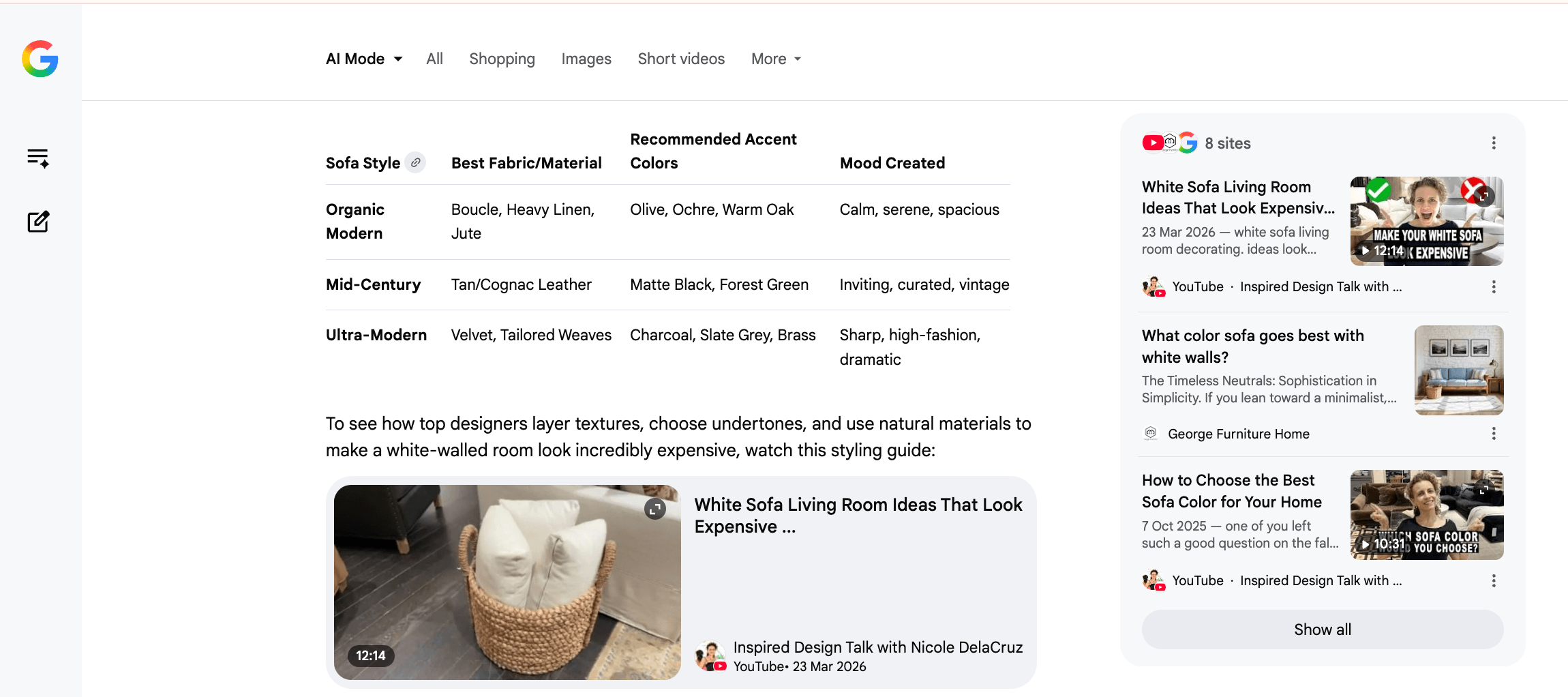
According to Google, AI-generated search experiences are increasingly incorporating images and video directly into AI Overviews and AI Mode responses. This represents a significant change from traditional search where text links dominated the search results page.
Google’s AI systems are now surfacing more visual assets alongside conversational answers, recommendations and summaries. This means businesses with strong visual libraries may gain a substantial visibility advantage as AI search evolves. For brands with extensive image assets, this creates a major opportunity.
Below is an example of a search query from Google AI Mode for “sofa’s to match white wall home”
Why Large Brands Have a Natural Advantage
Large brands often already possess enormous libraries of high-resolution visual content across catalogs, campaigns, product photography, social media assets, supplier imagery, showroom photography and lifestyle imagery.
This existing asset base is difficult for smaller competitors to replicate.
As AI-generated search becomes increasingly visual, brands with large volumes of trusted, high-quality and contextually relevant imagery are likely to become more visible within AI Overviews and conversational search experiences.
For example, travel companies such as Marriott International, Hilton and Airbnb already maintain massive image libraries featuring destinations like Miami, Aspen, Nashville, New York City and Honolulu. These visual assets help AI systems better understand travel-related searches and destination intent.
Furniture retailers like West Elm, Restoration Hardware and Crate & Barrel own extensive collections of professionally styled room imagery, interior inspiration galleries and product photography that naturally align with AI-powered recommendation systems.
Fashion brands including Ralph Lauren, Nike and Lululemon Athletica possess enormous campaign libraries, seasonal lookbooks and styling imagery that AI systems can surface alongside conversational fashion searches.
Homegoods retailers such as Williams-Sonoma, Pottery Barn and The Home Depot also benefit from deep image ecosystems showcasing renovation ideas, room inspiration and lifestyle content.
The Future of SEO Is No Longer Just Text
There has been significant industry discussion around how websites should structure content for AI systems. Topics like content chunking, FAQ formatting and semantic structure have dominated conversations around Generative Engine Optimization (GEO) and Answer Engine Optimization (AEO).
However, Google has indicated there is no strict requirement to aggressively “chunk” content into tiny sections purely for AI systems.
Instead, one of the more practical and impactful opportunities may simply be improving the quality, relevance and distribution of visual assets across a website.
This is particularly important because AI systems increasingly rely on multimodal understanding, meaning they process text, images and video together when generating responses.
In other words, websites are no longer competing purely on written content. They are competing on visual explainability as well.
Why Visual Content Matters Across Industries
AI-powered search is increasingly handling highly visual queries.
Users are now asking conversational questions such as:
“best luxury resorts in Scottsdale with mountain views”
“modern loft furniture ideas for apartments in Chicago”
“best oversized linen shirts for summer in Los Angeles”
“family-friendly wineries in Napa Valley”
“best modular sectional sofa for small New York apartments”
“coastal kitchen renovation ideas in Charleston”
In these searches, AI systems are more likely to favor websites that combine strong imagery with structured explanatory content, reviews, trust signals and contextual information.
This creates opportunities across many industries.
Travel brands can improve visibility through destination imagery, itinerary visuals and localized travel inspiration.
Fashion retailers can strengthen AI discoverability through structured product imagery, styling content and visual merchandising.
Furniture and homewares companies can improve visibility through room inspiration galleries, product comparison imagery and lifestyle photography.
Property developers, tourism operators, automotive brands, hospitality groups and e-commerce retailers may all benefit from richer visual ecosystems as AI search becomes increasingly image-driven.
Why Image Architecture Matters
Simply uploading more images is not enough. The structure, context and relevance of imagery now matter increasingly to AI systems.
This includes descriptive filenames, optimized alt text, semantic page relevance, image placement within content, supporting explanatory copy, internal linking context, image quality, uniqueness and topical relevance.
Google AI systems are becoming increasingly sophisticated at understanding visual context, meaning businesses should think strategically about how imagery supports user intent and topical authority.
For example, a travel website featuring professionally photographed hotels in Las Vegas alongside local guides and itineraries may strengthen AI understanding around destination expertise. Similarly, a furniture retailer using detailed room imagery alongside buying guides and design education may improve AI visibility for interior styling and furnishing searches.
AI Search Is Becoming a Brand Visibility Game
One of the most important shifts occurring right now is that businesses are no longer competing solely for blue-link rankings. They are competing to become retrieved, summarized, recommended, cited and visually surfaced inside AI-generated answers.
This changes how brands need to think about content strategy. Businesses with strong topical authority, trusted branding and deep multimedia assets are likely to gain disproportionate visibility advantages in AI-powered search environments.
The Opportunity Ahead
The transition toward AI-driven search is still in its early stages, but Google latest guidance makes one thing increasingly clear: visual content will play a much larger role in search visibility moving forward.
Businesses that invest in structured, high-quality and contextually relevant imagery today may gain substantial long-term visibility advantages across the future of AI-powered search.