
Google is dealing a final blow to websites.
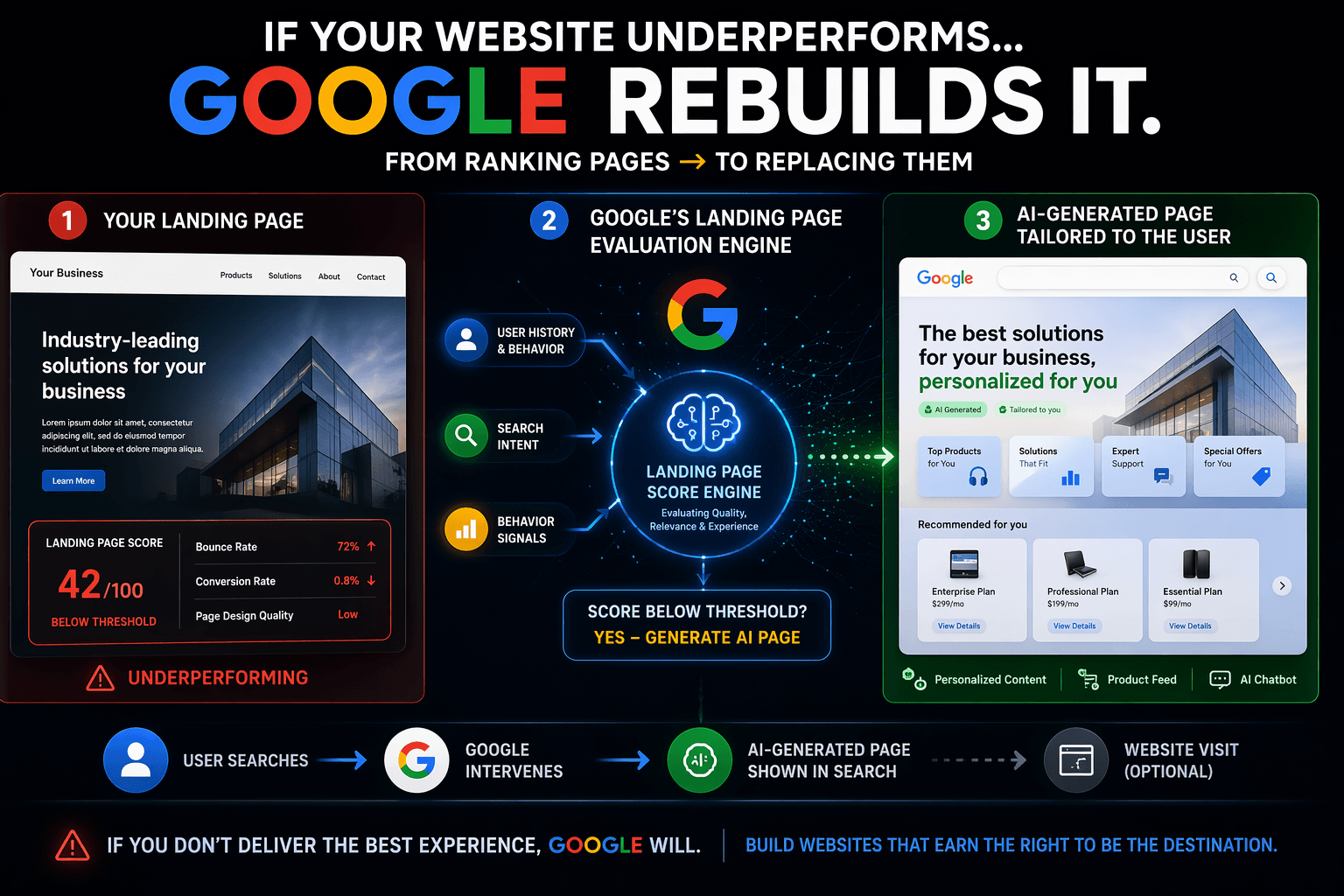
If you read Google Patent US12536233B1 Google will start to intercept the web user and create their own web pages instead. They want to become final destination, not just a traffic referrer. So how did we get here?
Phase 1: The “10 Blue Links” Era (Pre-2015)
Google acted purely as a discovery engine. Users searched, clicked, and websites owned the experience. Ranking #1 meant you controlled the narrative, the conversion funnel, and the brand interaction.
Phase 2: The Rise of “People Also Ask” (2015–Present)
Google’s move toward interactive, expanding search results began with the introduction of People Also Ask (PAA).
- 2015: Introduced quietly as a low-profile feature with just 3–4 related questions.
- 2017: Google added “dynamic loading,” meaning every click generated more questions, effectively creating an infinite scroll of query refinement.
- 2018 to Present: PAA boxes expanded aggressively and now appear on the majority of search results pages, often pushing organic listings further down.
This was a critical turning point. Google was no longer just answering queries, it was shaping and extending user intent in real time, keeping users engaged within the SERP itself.
Phase 3: Zero-Click & SERP Domination (2018–2023)
Following PAA, Google accelerated its push to retain users through:
- Featured snippets
- Knowledge panels
- Local packs (Maps integration)
- Video results (YouTube prioritisation)
- FAQ-rich results via structured data
The outcome was clear: fewer clicks leaving Google, more interactions happening inside it. Websites still mattered but their role was beginning to shrink.
Phase 4: Google AI Overviews (2024–Present)
With the rollout of AI Overviews, Google moved from aggregating content to synthesising it.
Instead of showing links, Google now generates full answers at the top of the page, pulling from multiple sources and presenting a consolidated response tailored to the query.
This fundamentally changes user behaviour:
- Users get answers without clicking
- Multiple sources are blended into one response
- Brand attribution becomes secondary to Google’s summary
For many queries, the website is no longer the destination, it’s just one of many inputs into Google’s AI layer.
Phase 5: AI-Generated Pages (The Patent – What Comes Next)
The patent “AI-generated content page tailored to a specific user” represents the next logical step.
If AI Overviews summarise content at the query level, this patent suggests Google could:
- Evaluate your landing page performance
- Determine it is underperforming
- Generate a replacement version of your page
- Personalise it based on the individual user
Google is no longer summarising the web, they are rebuilding it in real time.
The Strategic Implication for Website Publishers
This timeline shows a clear direction:
- First, Google organised the web
- Then, it started answering questions
- Then, it kept users inside its interface
- Now, it is generating the experience itself
For corporate websites, this is the inflection point. You are no longer just competing for rankings. You are competing with Google’s ability to replicate and optimise your experience better than you can.