ChatGPT Hits 1 Billion Weekly Users : How Do I index inside Generative AI Apps?

For over two decades, businesses focused on ranking in Google search results. Success was measured by website traffic, rankings, and clicks. Today, millions of consumers are bypassing traditional search engines and asking questions directly to AI assistants such as ChatGPT, Gemini, Claude, and Perplexity. Instead of receivinga list of links, users receive a complete answer generated from multiple sources across the web.

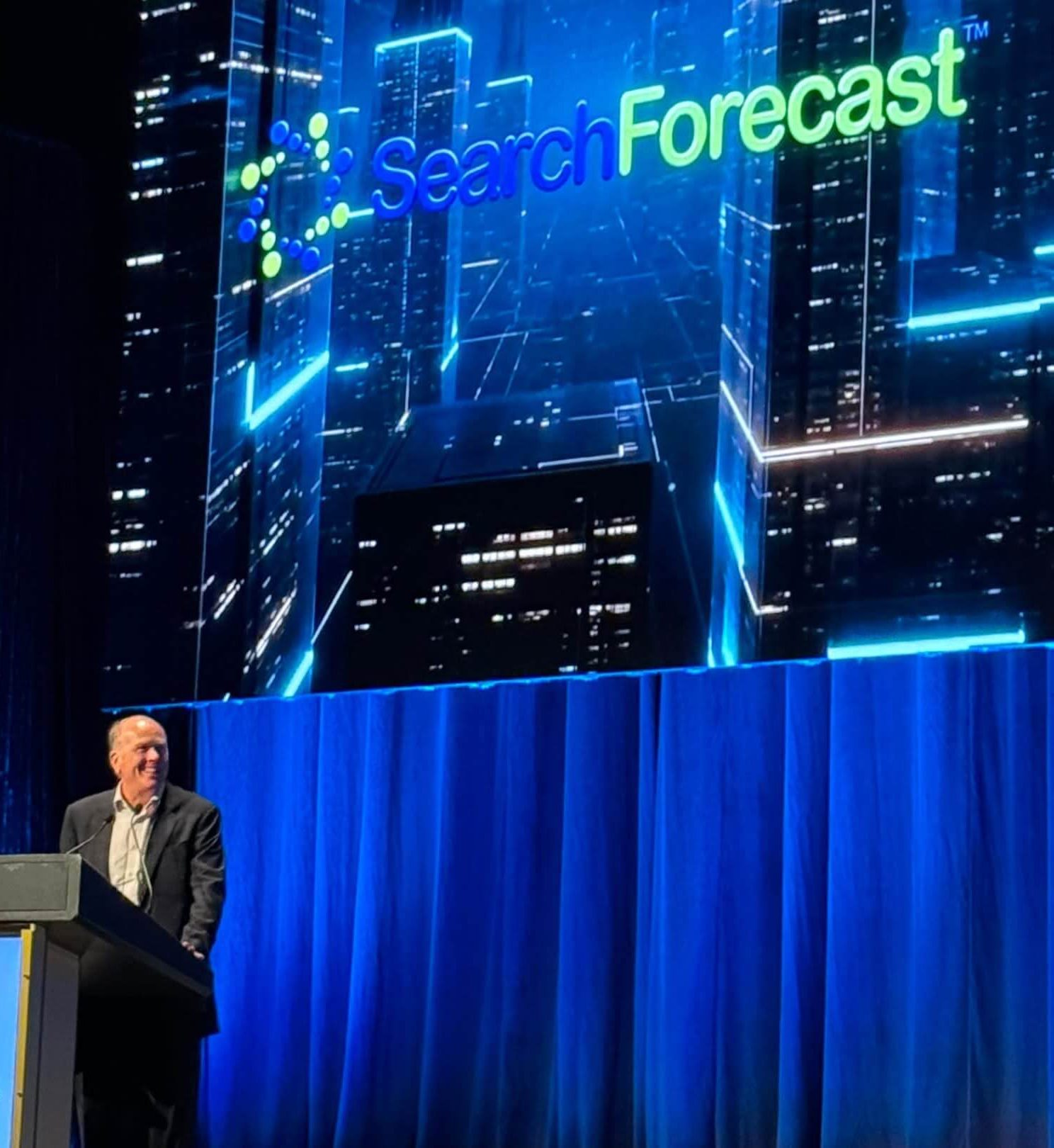
At a recent conference, Marc Phillips, CEO of SearchForecast spoke about how this change creates both challenges and opportunities for website publishers.
marc-phillips-searchforecast

The challenge is that users may no longer need to click through to a website to find an answer. AI platforms increasingly summarize information directly within the conversation. As a result, businesses that rely solely on traditional SEO strategies may see changes in how users discover their content.

The opportunity is that websites can now become sources cited and referenced by AI systems. When ChatGPT recommends a company, references an article, or cites an expert source, that visibility can influence purchasing decisions, brand awareness, and lead generation at an unprecedented scale.

This is where a new discipline known as Answer Engine Optimization (AEO) and Generative Engine Optimization (GEO) becomes critical. Rather than optimizing only for search engine rankings, businesses must optimize their websites so AI platforms can understand, trust, and reference their content. Research has shown that GEO strategies can significantly increase the visibility of content within AI-generated responses.

At SearchForecast, we help businesses adapt to this new reality through AI Optimization services that extend beyond traditional SEO. The company provides SEO, AEO, and GEO strategies designed to increase visibility within ChatGPT, Google AI Overviews, Gemini, Perplexity, and other emerging AI platforms. These services focus on improving content structure, authority signals, schema markup, entity optimization, citation opportunities, and machine-readable content that AI systems can confidently reference.

For website publishers, the message is clear. The internet is entering a new era where visibility is no longer determined solely by rankings on a search results page. Increasingly, success will be measured by whether your content is included in the answers generated by AI.

ChatGPT reaching one billion users is not simply another technology headline. It is evidence that AI-powered discovery has entered the mainstream. Businesses that invest now in AI Optimization, Answer Engine Optimization, and Generative Engine Optimization will be better positioned to capture visibility, authority, and customers in the years ahead.

The future of digital marketing is no longer just about being found in search. It is about being referenced in the answer.
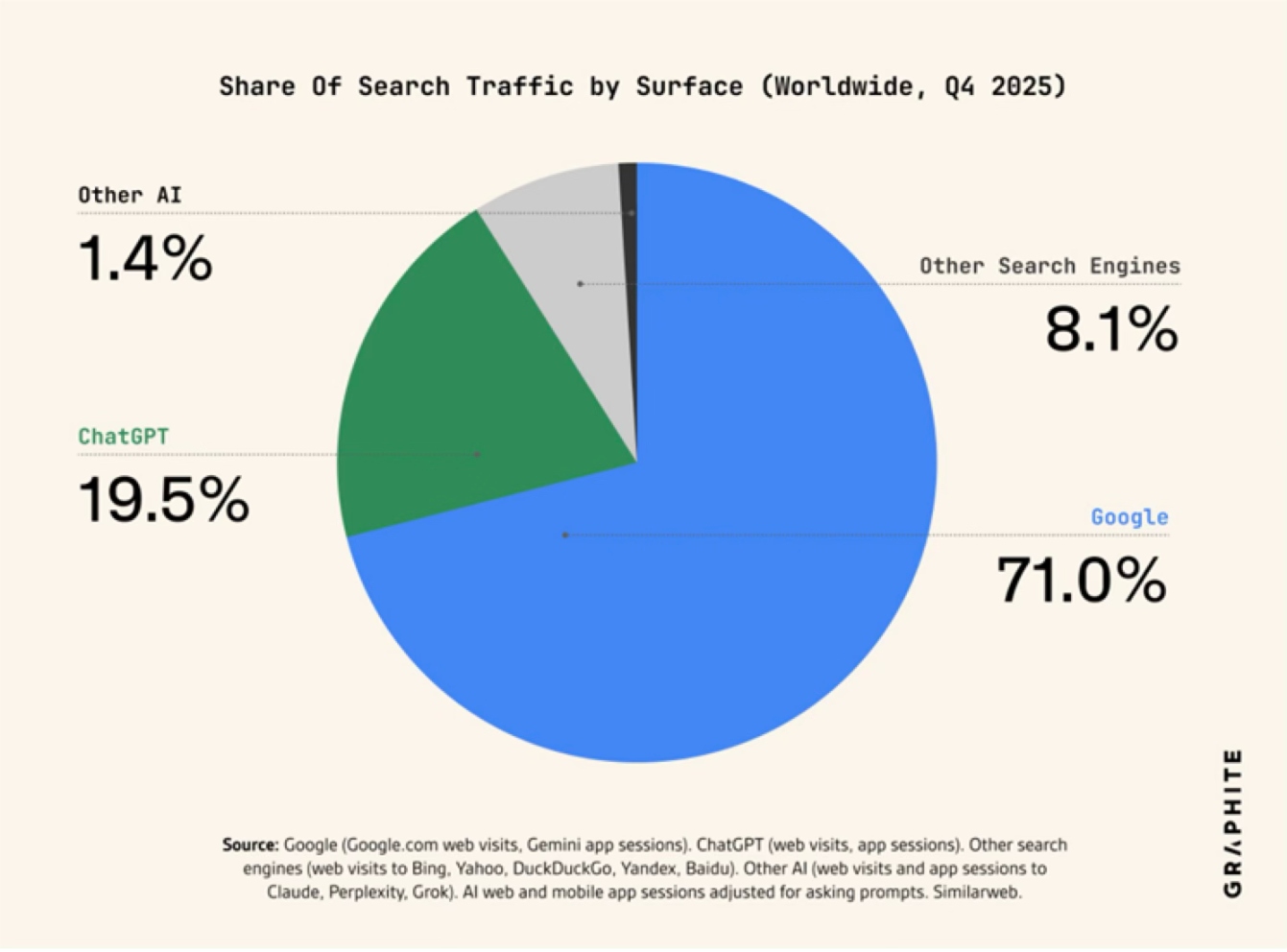
AI passes 20% of Search Traffic Share

So let this sink in …..

OpenAI’s ChatGPT has officially crossed an extraordinary milestone, reaching more than 1 billion monthly active app users in May 2026. According to Sensor Tower data, ChatGPT achieved this milestone in just three years, making it the fastest application in history to reach one billion users. It surpassed the growth trajectories of household names including TikTok, Instagram, YouTube, and Google Maps!

Designing ‘Prompt’ First Websites

The Future of Web Design Depends on Prompts: Lessons for the AI Website 2026 Strategy

Generative AI isn’t just transforming how people search — it’s redefining how websites must be built. The shift toward AI-driven discovery marks the arrival of the Answer Engine Optimization (AEO) era, where traditional SEO alone can no longer secure visibility. Instead, websites must be engineered to rank inside AI models, respond to natural-language prompts, and publish content in places LLMs actually look.

This changes everything about digital experience design, from navigation to content architecture to structured answers.

1. AI Has Become a Primary Discovery Surface — Even If Referral Traffic Is Still Small

AI referral traffic is still only a small fraction of total visits — around 1.08% — but nearly 90% of that comes from ChatGPT. Even though small today, this traffic is rapidly shaping early-stage customer journeys.

By 2026, AI Overviews will become “the page,” with 1 in 4 Google searches now replacing website clicks with AI-generated answers.

This forces brands to ask:

  • What answers does AI surface about my business? And which prompts trigger them?

Website design now becomes less about creating pages and more about creating answer-readiness.

2. Prompts Are Now the Starting Point of Your Website Strategy

The modern optimization process begins not with keywords — but with the questions customers ask.

Traditionally, websites were built around product categories, navigation menus, and brand messaging. In an LLM-first world, they must be constructed around the prompts customers naturally use, such as:

  • “What’s the best air purifier for allergies?”
  • “How do I choose a laptop for graphic design?”
  • “Which kitchen blender works best for smoothies?”

This means prompts drive:

  • Your content architecture
  • Your FAQ clusters
  • Your semantic URL structure
  • Your guides, how-to resources, and comparison content
  • Your external content distribution strategy

Modern websites become answer engines, not static brochures.

3. AI Models Pull From Specific URL Patterns — and Prompt-Optimized Content Wins

“Sources & Citations” insights clearly show:

  • AI models favor clear, natural-language, structured content that aligns directly with the prompt.

Key observations include:

Guides and Articles Get More Visibility

How-to guides, category explanations, and resource articles consistently appear more often in AI citations. This means websites must support answer-rich formats, not simply product listings.

Semantic URLs Increase Visibility

Conference insights show that semantic URLs increase visibility by 11.4%, reinforcing the need for URLs aligned with questions.

For example:

  • /best-air-purifier-for-allergies/ will typically outperform /air-purifiers/allergies/ in an AI context.

Gap Analysis Shows Prompt Intent Wins

If competitors rank for prompts like “best noise-canceling headphones,” it’s rarely a matter of quantity of content — it’s the alignment with prompt intent.

4. Prompt Volume Is the New Traffic Metric

AI Overview screenshots in the presentation show Google directly answering user prompts — without requiring a click to the website.

This leads to a major insight:

Prompt volume is the new page-view metric. Brands must optimize for inclusion in the AI answer, not just the search ranking.

To accomplish this, brands need:

  • Natural-language page titles
  • Conversational headers
  • Snippet-ready paragraphs
  • Structured Q&A for AI parsing
  • Rich media like YouTube videos and user reviews

In short: write for prompts, not pages.

5. Shift Toward Prompt-Led Content

The recent Zero Click Conference insights show:

  • FAQs appear 848% more often in AI responses.
  • Natural language URLs deliver +17% more rankings.
  • Product titles that are 18% longer perform better.
  • Videos get +103% more visibility.
  • Product ratings influence visibility by +36%.

These trends reflect a clear reality:

  • AI prefers conversational, structured, semantically rich content — the exact format customers use in prompts.

This is why prompts must guide the entire web design process.

6. Prompt Mapping

Identify the top 50–100 prompts customers ask and use them as your content blueprint and then

A. Publish Content Where AI Looks

Google Reviews, YouTube, Reddit, LinkedIn, community Q&A, and UGC platforms are now key sources that LLMs incorporate.

B. Scientific Experimentation

Publish prompt-based content → measure → adjust → re-measure.
Website design becomes iterative and data-driven.

Prompts Are the New Blueprint for Website Design

The era of designing websites around category trees and navigation menus is ending.

We have entered the Prompt-First Web, where:

  • Customers ask questions
  • AI answers them
  • Websites must supply the source material for those answers
  • Visibility depends on semantic clarity and prompt alignment

To win in 2026 and beyond, brands must build websites where every page is designed to answer a question — because prompts are now the gateway to discovery, relevance, and conversions.

Continue reading

The Impact of Ray‑Ban Meta AI Glasses on Web Traffic

Lining up on University Avenue in Palo Alto for one of the first Apple iPhones in the Summer of 2008 was memorable. You’ll be most likey reminded in years to follow of when you first walked past the Ray Ban sunglasses store as I did in Europe in July 2025 (taking this photo and buying a pair Ray‑Ban Meta AI glasses for €312 (excluding the 15% VAT rebate). It’s kind of cool, embedded AI, dual cameras, open-ear speakers, and hands-free voice control. Do I wear them? Not often as I prefer my Maui Jim’s and iPhone 16. Aren’t sunglasses designed to just keep out the sun and phones for talking / texting.

Yet taking photos / streaming video live is fun. Just need to hit the button on my Ray‑Ban Meta AI sunnies. Translating text on menu’s in Rome helped a little bit. I mean, you can just ask the waitor. Most people speak English right?

Meta is hoping to hit big with this consumer product which has Meta AI integrated, as more people start to use Generative AI apps like ChatGPT. Meta Quest sold around 500,000 virutal reality headsets in Q2, 2025. Compare that to the 45 to 50 million iPhones Apple sells each quarter.

Interesting Meta acquired a 3% stake in EssilorLuxottica (makers of Ray-Ban), worth roughly $3.5 billion in July 2025. Meta hopes to hit 10million sales in 2026.

Globally, around 157 million sunglasses (at an average ~$150 price point) sell each year. If Meta bring the price down, capture just 5% of that market, that’s nearly 8 million units per year—and billions in potential revenue. So will Meta / Ray-Ban sunnies sell like hotcakes? Ask Sergey Brin, co-founder who championed Google Glass which had a camera and Google Now Assistant built in.

The rise of AI glasses may actually decrease traditional website traffic—especially for search. With users asking Meta AI directly through voice commands (e.g., “What’s this building?”), the need to type queries into search engines or visit websites could decline.

One thing is for sure, AI interfaces disintermediating the web as we know if folks!


ChatGPT vs. Google: Can AI Disrupt the Search Engine Giant?

The search industry is facing a potential shake-up as AI tools like ChatGPT gain traction. While Google still dominates with 83.54% market share, ChatGPT is making waves, capturing an estimated 4.33% of search activity as of October 2024. For a platform just over a year old, that’s a significant milestone.

Unlike traditional search engines, ChatGPT provides conversational, context-aware responses that go beyond simple answers. With 300 million weekly active users and 1 billion daily messages, it’s clear that users are embracing this shift in search behavior. ChatGPT even outpaced Bing’s U.S. website traffic in September 2024, amassing 3 billion visits (SimilarWeb).

Generative AI is also gaining market dominance. ChatGPT leads with 59.2% share of the AI chatbot market, far ahead of Microsoft Copilot (14.4%) and Google Gemini (13.5%). This highlights how generative AI is redefining user expectations for search, prioritizing context-rich, actionable insights over traditional search formats.

However, challenges remain. Current data excludes in-app usage and API calls, meaning ChatGPT’s true market impact may be underestimated. Additionally, treating every prompt as a “search” oversimplifies its use case.

For search marketers, ChatGPT’s rise signals the need to adapt. Optimizing for conversational AI, leveraging AI tools for content creation, and integrating with platforms like ChatGPT are key strategies to stay ahead. As users increasingly value personalized, task-driven assistance, marketers must shift focus from traditional SEO to creating AI-friendly, conversational content.

The search landscape is evolving. While Google remains dominant, ChatGPT’s rapid growth is reshaping what’s possible. The question is no longer if AI will disrupt search—it’s how much. Are you ready to evolve with it?

Practical AI for Content Optimization

Artificial intelligence (AI) is for most people a mind bending concept. It’s easy to get wowwed by Amazon’s sensor rich ‘Go’ stores (video below) despite only 29 of them in the USA. Or Elon Musk’s Neuralink demo where 3 litlte pigs are running around with a implant to their skull/ cortext the size of a nickel.

Yet what business owners really want is practical AI they can use to improve sales activity, reduce costs and increase profits. Bear in mind that IBM Watson sees Strong AI as a 50 year timeline!

On that note, perhaps the best use of AI we have seen is Otter.ai which allows for video / audio transcription to text be done which allows simple content optimization at scale. For retailers or businesses sourcing customers from within local areas, automating content production using AI is critical.

While we wait for autonomous vehicles to arrive, perhaps the most pervasive AI is the applications like Calendly which help streamline appointment settings, allowing us all to spend time on more important work than back and forth emails to confirm meeting times.


Why Artificial Intelligence won’t replace humans

Many people theorize that artificial intelligence will make jobs redundant. Sure there will be some structural changes like all employment sectors go through as economies mature yet human’s will not be replaced. With over 7 billion people on the planet growing to around 10 billion by 2050, it’s important we understand that artificial intelligence is about giving computers a set of tools, a problem to solve and they find the solution, not giving computers step by step instructions to do human work.

While you might want to read about the threat population growth has to our planet which Thomas Robert Malthus predicted in his Essay on the Principal of Population, there is also a case for taking into account the future of space exploration and how that may help solve the ultimate resource issues of planet earth. So does artificial intelligence hold the answer?

Some technologist are looking beyond autonomous vehicles and in the book ‘No Higher Ground‘ by author Roman Godzich helps us understand how exploration has it’s reward and pitfalls.

What Artificial Intelligence really means

It’s getting ridiculous. My Uber driver today was telling me how AI is changing the world. I just wish they knew how to change lanes safely. See below. That’s how you should think about Artificial Intelligence.

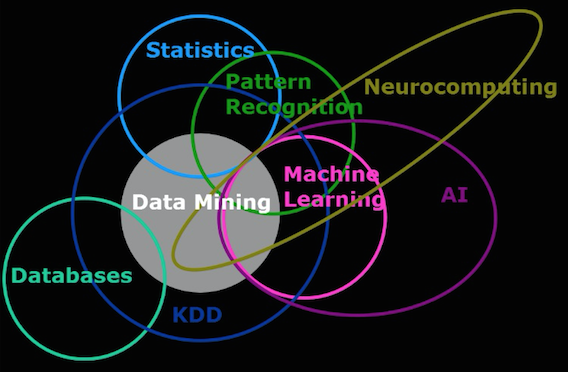
The core of AI is data and and statistics. Somehow that got manifested or redefined into Data Mining (the proceed of retrieval and extraction/ collection) then analysis (statistics, pattern recognition) and then machine learning. So many buzz words. This information is stored in databases and that is often referred to as knowledge discovery in databases (KDD) … then AI came around to bamboozle investors thinking there was some secret sauce beyond Data Mining and Machine Learning.  This graphic is a good one to I like to share. AI is just an extension of all these core ingredients.

Screen Shot 2017-09-27 at 7.45.44 PM