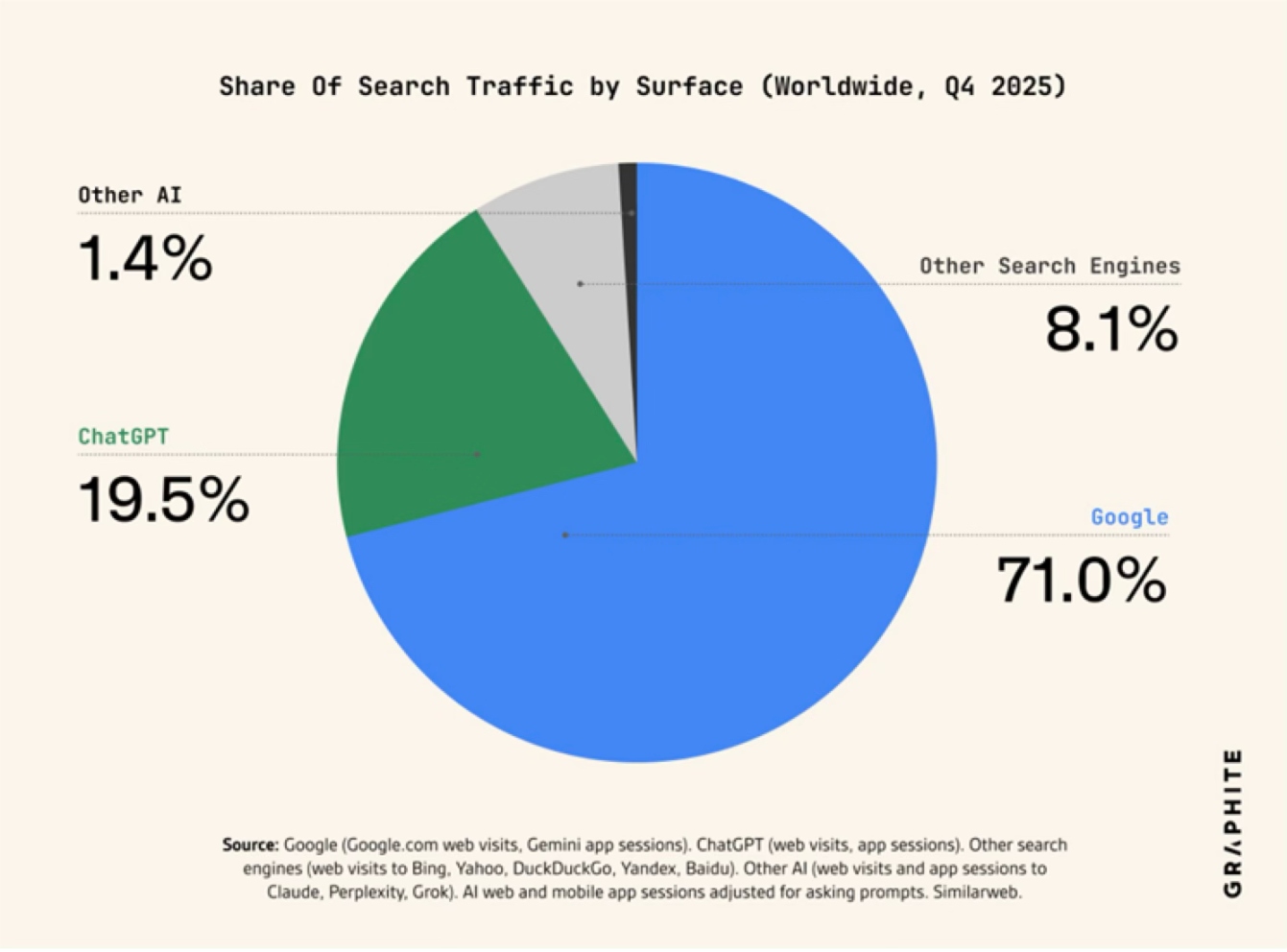
OpenAI’s ChatGPT has officially crossed an extraordinary milestone, reaching more than 1 billion monthly active app users in May 2026. According to Sensor Tower data, ChatGPT achieved this milestone in just three years, making it the fastest application in history to reach one billion users. It surpassed the growth trajectories of household names including TikTok, Instagram, YouTube, and Google Maps!
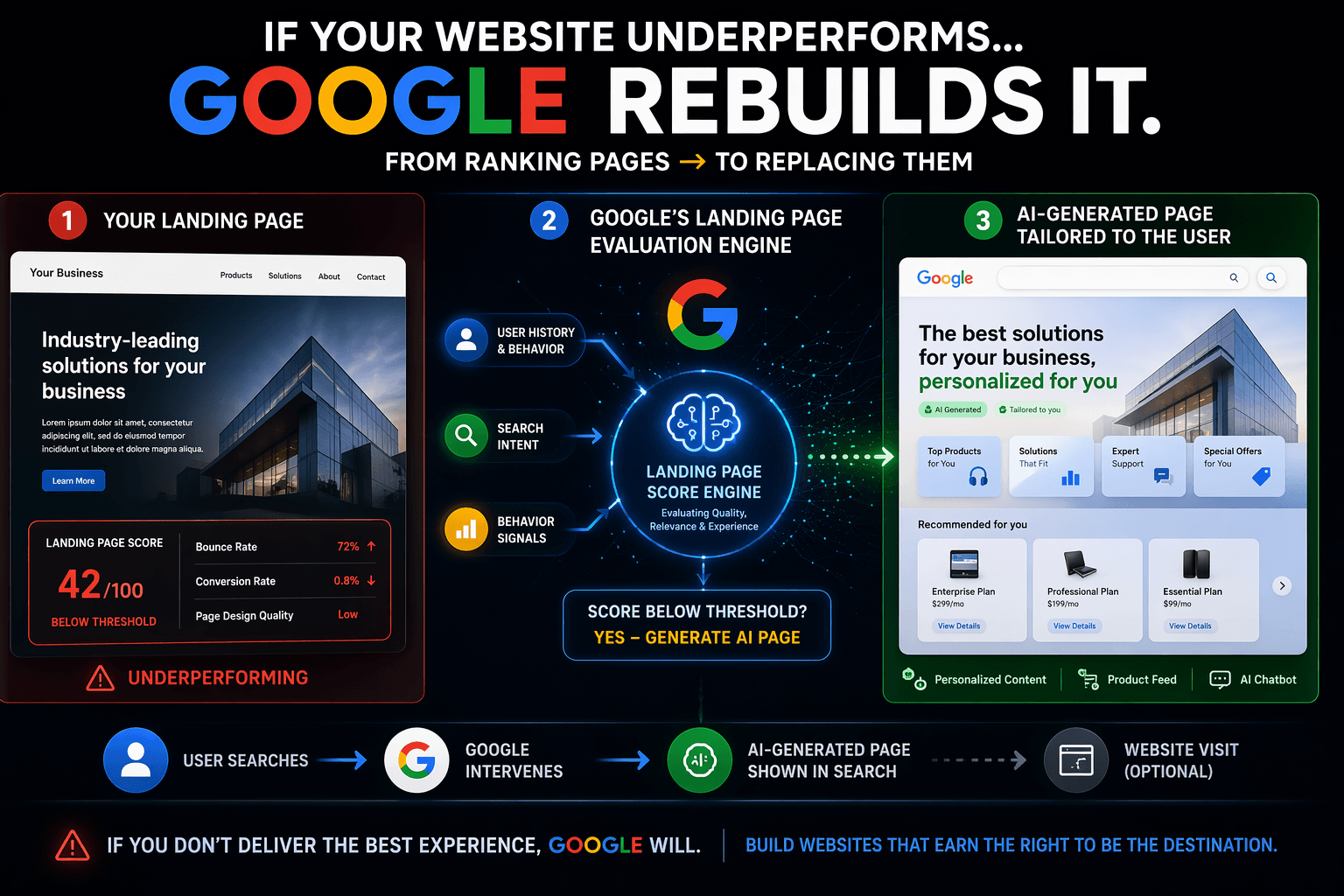
If you read Google Patent US12536233B1 Google will start to intercept the web user and create their own web pages instead. They want to become final destination, not just a traffic referrer. So how did we get here?
Phase 1: The “10 Blue Links” Era (Pre-2015)
Google acted purely as a discovery engine. Users searched, clicked, and websites owned the experience. Ranking #1 meant you controlled the narrative, the conversion funnel, and the brand interaction.
Phase 2: The Rise of “People Also Ask” (2015–Present)
Google’s move toward interactive, expanding search results began with the introduction of People Also Ask (PAA).
2015: Introduced quietly as a low-profile feature with just 3–4 related questions.
2017: Google added “dynamic loading,” meaning every click generated more questions, effectively creating an infinite scroll of query refinement.
2018 to Present: PAA boxes expanded aggressively and now appear on the majority of search results pages, often pushing organic listings further down.
This was a critical turning point. Google was no longer just answering queries, it was shaping and extending user intent in real time, keeping users engaged within the SERP itself.
Phase 3: Zero-Click & SERP Domination (2018–2023)
Following PAA, Google accelerated its push to retain users through:
Featured snippets
Knowledge panels
Local packs (Maps integration)
Video results (YouTube prioritisation)
FAQ-rich results via structured data
The outcome was clear: fewer clicks leaving Google, more interactions happening inside it. Websites still mattered but their role was beginning to shrink.
Phase 4: Google AI Overviews (2024–Present)
With the rollout of AI Overviews, Google moved from aggregating content to synthesising it.
Instead of showing links, Google now generates full answers at the top of the page, pulling from multiple sources and presenting a consolidated response tailored to the query.
This fundamentally changes user behaviour:
Users get answers without clicking
Multiple sources are blended into one response
Brand attribution becomes secondary to Google’s summary
For many queries, the website is no longer the destination, it’s just one of many inputs into Google’s AI layer.
Phase 5: AI-Generated Pages (The Patent – What Comes Next)
The patent “AI-generated content page tailored to a specific user” represents the next logical step.
If AI Overviews summarise content at the query level, this patent suggests Google could:
Evaluate your landing page performance
Determine it is underperforming
Generate a replacement version of your page
Personalise it based on the individual user
Google is no longer summarising the web, they are rebuilding it in real time.
The Strategic Implicationfor Website Publishers
This timeline shows a clear direction:
First, Google organised the web
Then, it started answering questions
Then, it kept users inside its interface
Now, it is generating the experience itself
For corporate websites, this is the inflection point. You are no longer just competing for rankings. You are competing with Google’s ability to replicate and optimise your experience better than you can.
For years, digital strategy revolved around one goal: rank higher on Google. Get to page one. Capture the click. Drive traffic.
That was SEO. But in 2026, search has evolved into something much bigger. Google now delivers AI summaries before links. Users ask conversational questions. Platforms like ChatGPT generate complete answers instead of showing ten blue results.
Today, visibility is no longer just about ranking. It’s about being referenced, extracted, and cited.
Welcome to the era of SEO, AEO, and GEO.
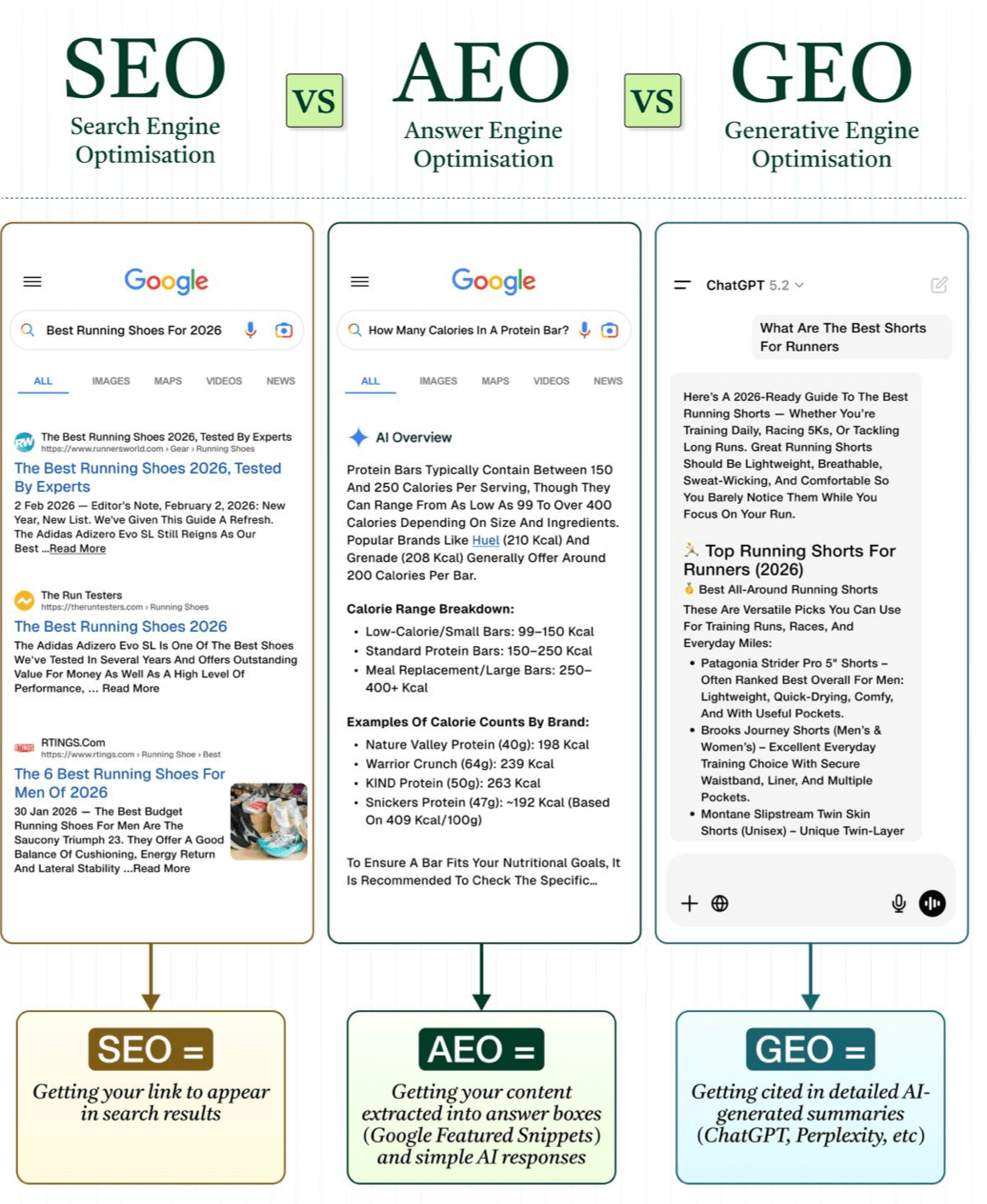
SEO: Getting Your Link to Appear
Search Engine Optimisation (SEO) is the foundation. It’s about making sure your website appears in traditional search results when someone types in a query.
If someone searches “Best Running Shoes for 2026,” SEO determines whether your article ranks on page one or disappears into obscurity.
SEO focuses on keywords, backlinks, technical performance, site structure, authority, and user experience. The objective is simple: earn the click and drive traffic to your website.
SEO is still essential. It’s still powerful. But it’s no longer the full picture. Because now, users don’t always click.
AEO: Getting Extracted Into the Answer
Answer Engine Optimisation (AEO) is the next evolution.
When someone searches, “How many calories are in a protein bar?”, Google often displays an AI-generated overview or featured snippet before any traditional links.
That summary pulls structured information from multiple sources and presents a clean, direct answer.
That’s where AEO comes in.
Instead of just ranking, you optimise your content so that it can be extracted into those answer boxes. Clear formatting. Concise explanations. Direct responses to specific questions. Schema markup. FAQ structures.
The goal shifts from “get the click” to “become the source inside the summary.” Even if traffic decreases slightly, authority increases. Your brand becomes embedded inside Google’s AI layer.
GEO: Getting Cited in Generative AI
Now we move beyond search engines.
Generative Engine Optimisation (GEO) focuses on platforms like ChatGPT and other AI assistants. When someone asks, “What are the best running shorts for 2026?”, they don’t receive links. They receive a detailed, conversational response.
That response may mention brands, reference expert sources, and summarise recommendations.
If your brand appears inside that generated answer, you’ve achieved GEO.
GEO isn’t about ranking for keywords. It’s about building authority across the web so AI systems recognise your brand as credible and relevant.
This involves original insights, expert commentary, high-quality mentions, digital PR, structured content, and consistent topical depth. The objective is not traffic. It’s citation.
At SearchForecast, we work with ambitious businesses and visionary founders to build digital platforms that solve real-world challenges. Today, we’re proud to announce the launch of CREAM.com.au, a purpose-built website designed to connect commercial borrowers with over 800 expert finance brokers across Australia.
CREAM.com.au is not just another finance comparison site. It’s a highly targeted, commercial finance marketplace developed specifically for property owners, developers, and larger businesses looking to access structured lending solutions that are often not available through traditional banking channels or local brokers.
Our brief from the CREAM.com.au team was clear: develop a platform that empowers borrowers to find brokers who understand their industry, the assets they’re financing, and the type of loan they require. We worked closely with their team to design a user experience that is streamlined, transparent, and genuinely useful to businesses navigating complex finance needs.
Behind the site is a robust matching engine that categorises brokers by sector expertise, asset specialisation, and financial product knowledge. This means a borrower looking for a commercial property loan in the construction sector can quickly be connected with brokers who understand presale requirements, funding stages, and lender expectations. Similarly, a business in the transport or manufacturing industry seeking asset finance for trucks or earthmoving equipment can be matched with brokers who have relevant experience and lender access.
Our development team built out a comprehensive classification system for CREAM.com.au, allowing borrowers to search across industries such as agriculture, construction, healthcare, hospitality, IT, manufacturing, and retail. We also ensured asset types are clearly defined—from tractors and solar systems to medical equipment, trucks, fleet vehicles, and more. On top of that, users can specify the finance product they’re looking for—be it working capital finance, commercial hire purchase, mezzanine debt, or equipment finance.
What makes this platform different—and what we’re most proud of from a product standpoint—is its business-first approach. While most loan sites cater to consumers seeking personal loans or mortgages, CREAM.com.au focuses exclusively on the commercial market. It’s built for companies, developers, and operators who often need bespoke finance solutions, fast turnaround, and brokers who understand the intricacies of their industry.
The submission process for borrowers is simple but powerful. Users complete a single enquiry form, and their information is securely shared with a select pool of qualified brokers. These brokers then review the details and, if they’re a good fit, respond directly with tailored finance scenarios. This model removes unnecessary middlemen and creates direct communication between borrower and broker—something many businesses value when navigating high-stakes funding decisions.
SearchForecast also developed CREAM.com.au with future scalability in mind. The architecture supports the onboarding of more brokers, deeper categorisation of asset classes and industries, and enhanced search and filtering capabilities. We’ve built the foundation for what we see as a long-term platform that will evolve alongside Australia’s commercial lending market.
From a digital strategy perspective, CREAM.com.au is designed to grow its organic reach through well-structured content, sector-specific landing pages, and SEO-optimised pathways tailored to how businesses actually search for finance.
We’re excited to see how CREAM.com.au transforms how commercial borrowers find finance brokers across Australia. If you’re a commercial property developer, construction business, or enterprise-level borrower, this platform was built for you.
Google has announced its intent to acquire Wiz, a leading cloud security platform, for $32 billion. Biggest acquisition ever. Sure it’s to compete against Microsoft Azure & Amazon AWS yet how does it fit with Google Ads which generates US$265 billion in 2024 (75% of its total revenue)?
While Google’s acquisition of Wiz aims to bolster its cloud security offerings by identifying vulnerabilities, assessing risks, and providing actionable insights to protect cloud environments, there has been no official announcement regarding the integration of Wiz’s technology into Google’s Ads or SEO tools or services.
Which is the bigger threat? Hackers and bad actors trying to hack servers or stopping bots clicking on Google ads and ad-fraud in general. I guess by the size of the Wiz paid sticker, you might think it’s the former.
Programmatic SEO is database driven content that increases the reach and frequency of published web pages on your website in search engines. It’s typically done using specifically written content pages that dynamically change keywords based on either locations or other content variables. Here’s a few examples from clients.
https://www.avasflowers.net/local-florists has thousands of SEO pages programmatically driven via database calls.
Last year SearchForecast built a 2 sided marketplace platform for Australian website Cellars.com.au which you can read about here. We are excited to announce SEMRush recently included Cellars.com.au as a ‘Game Changer’ in their Competitive Quadrant. A “Game Changer” is defined by SEMRush as an “emerging website with a high growth potential.” In less than 18 months, 400+ wineries are now drop-shipping over 3,500 wine on their platform. 100% of the traffic is organic courtesy of our search engine optimization techniques.
Earlier this year I was back in Sydney and went into a Commonwealth Bank only to find the music blaring, 3 ATM machines and a lady standing there glancing up to smile before returning to tap away on her iPhone. No tellars. Do it yourself. Fast forward 6 months and I’m in Santa Monica and confronted with this sign. At least I was able to buy a coffee while getting out some cash. My kids and your kids dont use cash. They tap. Like the lady in the Commonwealth Bank. Ironic right?
When Amazon purchased Wholefoods, all of us in the Bay Area thought it was a bold move and wondered if prices or quality of foods would diminish. I almost hit my head on the glass casing when I rounded the isle in Wholefoods Redwood City one afternoon. Progress my friends. Disruption works for most people. I now drink coffee more at home, do most of my shopping/ banking via an app.